By Janney Kayastha
Before going to Ghyangphedi, I didn’t know much about the place. I wasn’t aware that it lies within the buffer zone of Langtang National Park or that it had a history with poverty and human trafficking. Our team reached the village at night, so there was little to see, just darkness, quiet trails, and fatigue from travel.
Ghyangphedi revealed itself the next morning.
When I woke up, the scene felt almost unreal. The village sat gently between two flowing rivers, surrounded by green hills and rich biodiversity. The air was fresh, the landscape calm, and the setting incredibly beautiful. Ghyangphedi lies along the trail leading to Gosaikunda, a sacred pilgrimage site and a popular trekking destination, placing the village at an important ecological and cultural crossroads. I later learned that there have been red pandas sightings in this area. At first glance, this didn’t look like a place with any kind of serious environmental problem.
Tourism here is clearly working, homestays are growing, livelihoods have improved, and there is visible pride in the community’s achievements. Yet, this was precisely why we were there, to facilitate a community level waste management workshop. On the surface, everything seemed fine, but rapid tourism and modernization are quietly introducing new challenges the village had never faced before.
When Success Brings Invisible Problems
What struck me early on was that waste wasn’t visible along the main walking trails. Everything looked clean and well-maintained. During a brief morning walk through the village, we learned that with no waste management option beyond organic waste, non-biodegradable materials were either burned or dumped in nearby rivers. Burning plastic contributes to air pollution, while dumping waste into rivers poses a growing risk of water pollution, especially during the monsoon season when waste is easily carried downstream.
The community members were honest about this. They didn’t deny the issue. In fact, many openly acknowledged that waste might not be a major problem today, but if nothing changed, it would certainly become one in the future. That awareness stood out to us.
Ghyangphedi’s waste challenge is not a result of neglect or failure. It is a byproduct of progress. As tourism grew, so did the use of packaged food, bottled drinks, toiletries, and construction materials- things the village never had to deal with before. Organic waste was always manageable. Plastic was not.
The Workshop and a Shift in perspective
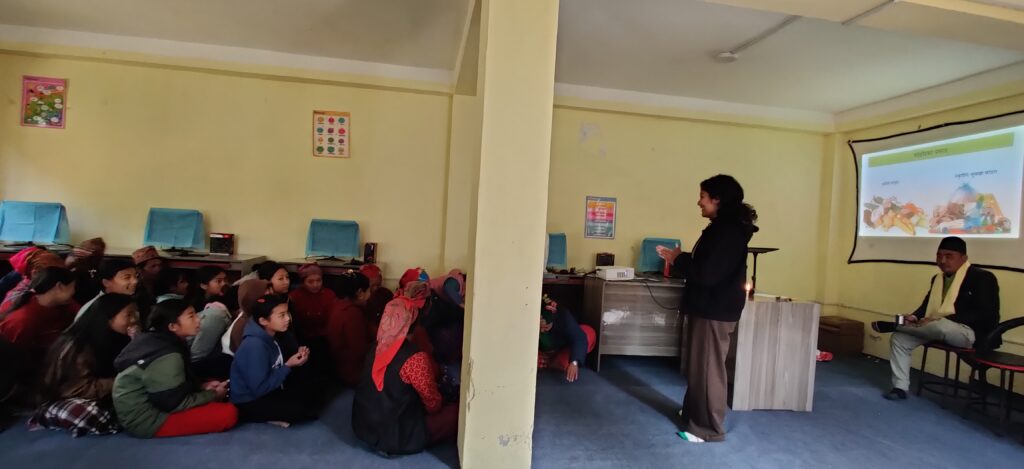
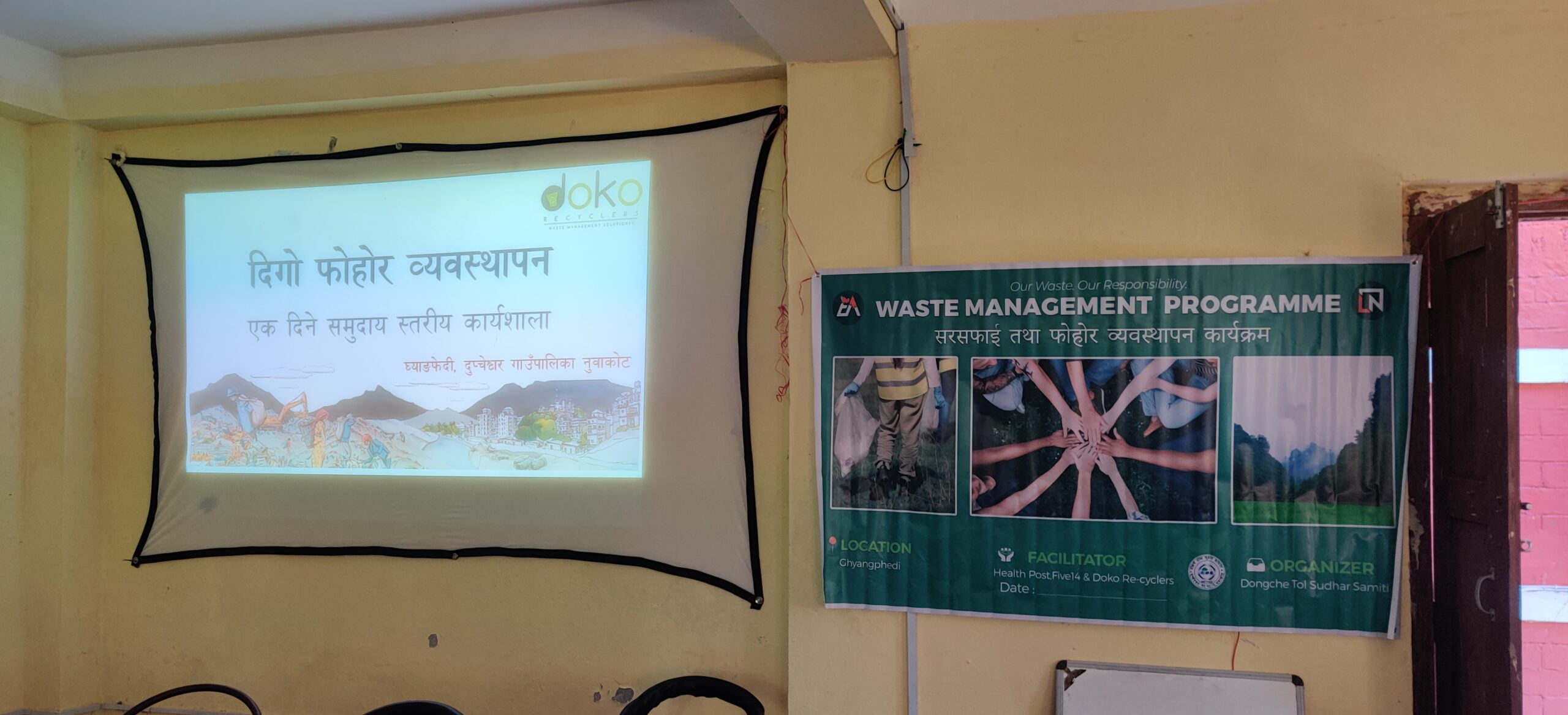
Dongche Tole Sudhar Samiti took the lead in organizing the workshop, while Five 14 provided implementation support and Doko Recyclers provided technical guidance throughout the process. The workshop felt less like a formal program and more like a community gathering. Around 40 participants; students, teachers, homestay operators, health workers and community leaders, came together to share, listen, and learn from one another. More than half of the participants were women, shaping the conversations in meaningful ways. The Ward Chairperson’s presence encouraged the community to take the responsibility and stay committed to the cause,reinforcing a shared sense of responsibility and commitment.
At the beginning, waste was mostly discussed as a household issue. Burning and dumping were described as common practices. But as we moved into discussions on waste segregation, plastic categories, decomposition timelines, and composting, the conversation began to shift. One moment stayed with me. During a group discussion, a participant asked, “You mean this never goes away? It stays here, in the environment, long after we’re gone?”
That simple question captured the realization many were having at that moment, that plastic waste is not temporary, and hiding or burning it doesn’t make it go away.
What We Took Away
There were a few important lessons we carried back with us to Kathmandu:
First, development creates new vulnerabilities. When livelihoods improve, consumption patterns change. As tourism picks up and homestays grow, communities begin to bring in more packaged foods, bottled drinks, and disposable items. If communities aren’t supported to manage those changes, their hard-earned progress is put at risk.
Second, mindset matters more than infrastructure. Collection vehicles, landfills, material recovery facilities and other external systems are pointless until communities are clear on what and how their waste can be managed locally and what cannot. This can impact both consumption choices and how waste is managed from the beginning, both at an individual and household level.
Third, real change comes from within the community. The most promising change agents weren’t outsiders, they were schools and homestays. Students take lessons home and homestays influence both tourists and neighbors through daily practice.
Looking Ahead:
The community inspired me the most by showing eagerness to take action early and actively committing to positive change. People didn’t see waste as, “someone else’s problem,” or something to worry about later. They wanted to take steps now- before the problem becomes visible, unmanageable, and harmful.
From a practical perspective, the path forward is clear:
- Segregating waste at the source into categories so that resources can be recovered and decomposition can be avoided thus reducing Greenhouse Gases.
- Treating composting as essential infrastructure, which helps manage organic waste locally and use the manure for agriculture.
- Placing bins where waste is actually generated so that there is no littering, and people throw waste in the proper bins, leading to a higher segregation rate.
- Creating clear community rules against burning and dumping, which will discourage harmful practices and reduce environmental pollution.
- Building linkages so recyclables can leave the village, allowing the materials to enter the recycling chain instead of being wasted or burned.
- And, most importantly, keeping the conversation alive beyond a single workshop, which will reinforce awareness and encourage long-term behavioral change in waste management.
A Final Reflection
As a facilitator, I often wonder what truly remains after a workshop ends. In Ghyangphedi, I left with cautious optimism – there seems to be a willingness and potential to adopt sustainable practices.
This is a village that has already overcome far greater challenges. Waste management here is not just about cleanliness, it is about protecting livelihoods, ecosystems, and the future of a place that has worked hard to succeed. The challenge does not lie in progress itself, but in our failure to address its social and environmental impacts.